Share




There is a quiet lie we have told ourselves for years in the Kenyan construction industry, and like all quiet lies, it has become dangerously comfortable.
We have convinced ourselves that if a drawing bears the stamp of an architect, the calculations of an engineer, and the signature of a quantity surveyor, then the building that follows must be sound, coherent, and worthy of the land it stands on but anyone who has driven through our towns, from the leafy edges of Runda to the restless growth of Kitengela knows this is not entirely true. The evidence is everywhere: bungalows squeezed between flats, maisonettes shadowed by poorly considered extensions, neighborhoods that feel less like planned environments and more like arguments that were never resolved.
This is not a failure of intelligence. It is not even a failure of training. It is a failure of systems.
Because the current pre-construction process, as practiced across much of Kenya, is not designed for coherence, it is designed for compliance in fragments. The client appoints an architect, who develops the drawings. The structural engineer comes in, often working in parallel but not always in full integration. The mechanical and electrical engineers follow suit. The quantity surveyor prepares a bill of quantities. These documents are then assembled like a patchwork quilt and submitted to the county for what we boldly call a “building permit.” But let us be honest with ourselves: it is not truly a building permit. It is closer to a planning submission, a regulatory checkpoint that confirms minimum compliance, not maximum harmony.
And so, the system approves buildings, but it does not curate environments.
Each professional, highly trained and competent in their own right, operates within their silo. Coordination meetings, where they exist, are often driven by contractual obligation rather than true collaboration. In more informal, self-build scenarios, the reality for a majority of Kenyan homeowners, this coordination is even weaker. The client, now wearing the hats of developer, project manager, and financier, becomes the point of convergence, often without the tools, training, or time to manage that responsibility effectively. The result is predictable: misalignment, inefficiencies, cost overruns, and in many cases, compromised outcomes.
Now, here is where the conversation shifts from critique to opportunity.
The future of construction will not be defined by who holds the most certificates, but by who can operate most effectively within integrated systems. This is where Building Information Modelling (BIM),now supercharged by artificial intelligence, enters not as a luxury, but as a necessity. BIM is not merely a software. It is a philosophy of working. It demands that architects, engineers, and consultants do not just contribute to a project, but co-create it in a shared digital environment. One model, one source of truth, one continuously evolving dataset.
In such a system, the structural engineer does not “interpret” the architect’s drawings, they work within the same model. The mechanical and electrical layouts are not overlaid as afterthoughts, they are embedded from the beginning. Clashes are detected before they reach site. Quantities are extracted in real time. Costs are not guessed; they are calculated dynamically. And perhaps most importantly, accountability becomes visible.
Now imagine extending this system beyond the design team.
Imagine a pre-construction process where the moment a design is developed, it is automatically checked against county regulations, setbacks, height restrictions, zoning requirements, environmental considerations, all validated in real time. No back-and-forth. No ambiguous forms. No delays driven by missing information. The submission process becomes a matter of seconds, not weeks. The system flags what is non-compliant before it is ever sent. The client does not need to understand the bureaucracy because the system has already translated it into logic.
Yes, today, our counties may still lag behind. The forms are manual, the processes slow, and the interpretation inconsistent. But it would be a mistake to assume this will remain so. Governments, like markets, eventually respond to pressure. And the pressure is building, from technology, from urbanization, from the sheer inefficiency of current systems. Whether we like it or not, automation is coming, and it will not politely wait for us to catch up.
By the time we approach 2047, it is not far-fetched to imagine a regulatory environment where approvals are largely automated, where data flows seamlessly between private consultants and public authorities, and where the role of human oversight shifts from processing paperwork to managing exceptions. Whether we call it an AI-assisted county or a digital planning authority is a matter of language. The reality will be the same: faster, stricter, and far less forgiving of disorganization.
And this is where the real disruption lies.
Because in such a world, the advantage will not belong to the professional with the longest list of qualifications, but to the one who can operate within, and lead, these systems. Collaboration will become a core skill. Not the polite kind discussed in boardrooms, but the technical, disciplined, model-based collaboration that BIM demands. The ability to work across borders, to plug into international teams, to deliver projects remotely while maintaining local relevance, this will define the next generation of professionals.
For the Kenyan construction ecosystem, this presents both a threat and an extraordinary opportunity. A threat to those who remain anchored in fragmented, document-based workflows. An opportunity for those willing to build structured, transparent, and integrated systems that align skill with verifiable outcomes.
Because at its core, this is not a debate about degrees versus skills. It is about credibility.
Degrees will remain important. They provide foundational knowledge, professional grounding, and in many cases, legal legitimacy. But they are no longer sufficient. The market is shifting toward a more demanding standard: proof of execution, clarity of process, and reliability of outcome. Clients are becoming more aware, more cautious, and more value-driven. They may not articulate it in technical terms, but they feel the difference between a project that is managed through systems and one that is managed through hope.
And so, the question is no longer whether the industry will change. It already is.
The real question is: who will build the systems that define this new standard?
Because those systems, whether they are platforms, workflows, or integrated service models, will become the new gatekeepers of trust. They will determine who gets work, who commands premium pricing, and who is left behind explaining why things did not go as planned.
For firms like Ololapopo & Company, and for platforms like Kandarasi House, this is not a distant future. It is a present mandate. To move beyond coordination and into orchestration. To move beyond delivering projects and into designing the systems that make good projects inevitable.
The industry does not need more drawings. It needs better alignment. It does not need more approvals. It needs more coherence. And it does not need fewer professionals. It needs professionals who can work as one.
If you are a homeowner, developer, or self-builder, the next time you begin a project, do not just ask who will design it. Ask how the entire process will be managed, integrated, and verified from start to finish. Demand systems, not just services.
If you are a professional, the challenge is even clearer. Invest not only in your qualification, but in your ability to collaborate, to operate within digital environments, and to deliver outcomes that can be measured, tracked, and trusted.
And if you are ready to experience what a structured, system-driven approach to construction looks like, from concept to completion, then it is time to engage with a team that is already building this future.
Because in the end, we are not just in the business of putting up buildings.
We are in the business of building trust.
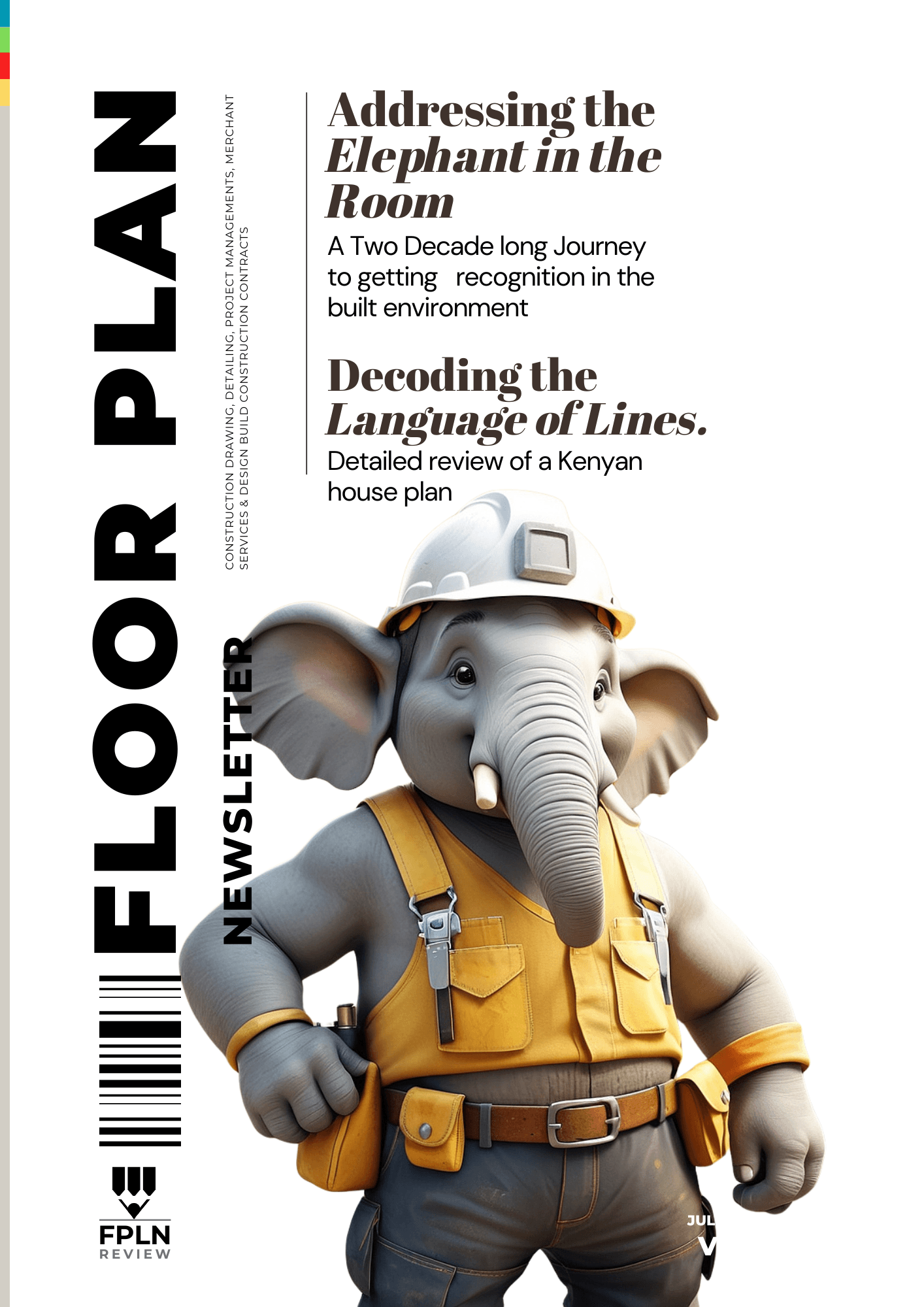
FLOOR PLAN
The latest issue is available in print and digital format