Share




Your cousin’s fundi may be a genius with cement, but without a plan, you’re just making expensive guesses in concrete.
If you’re reading this from a WhatsApp group called “Plot Ya Mwaka”, then allow me to greet you properly, karibu sana to the club of dreamers, hustlers, and future landlords who have bought land somewhere between hope and a dusty road that Google Maps still refuses to recognize. You have your 50×100, the caretaker is already calling you “boss,” and every time you pass by the plot, you stand there with hands behind your back like a retired general inspecting land you don’t yet understand. The next step, naturally, is to build, and like all good Kenyan decisions, the strategy is simple! “We start. Mengine tutajua mbele.”
Now let me save you before you become a case study.
Because somewhere between that first trench and the second emergency chama contribution, many self-builders in Kenya discover a painful truth, building without a plan is not bravery, it is financial self harm in slow motion. The cement does not forgive ignorance. The fundi does not refund mistakes and gravity, my friend, does not negotiate.
Kenya today is experiencing a quiet revolution not the kind that makes headlines, but the kind that shows up in mabati roofs in Kitengela, bungalows in Ruiru and half-finished dream homes in Kisumu. The real estate developers may dominate billboards, but the real builders of this country are the self builders, the ones who save for years, buy land, and then build step by step like a man assembling his future with bare hands. These are not careless people, these are determined people but determination without direction is how good intentions become expensive lessons.
Let us be honest with each other, the system has not made it easy, you walk into a county office and are told about approvals, submissions, drawings and consultants as if you are about to build Parliament. You walk out, meet a fundi who assures you he has built “many houses in this area,” and suddenly that sounds more reasonable than paperwork and professionals. And just like that, you have chosen convenience over clarity. Not because you are foolish but because the system pushed you there.
Here is where the story becomes uncomfortable, because while the system is broken, many selfbuilders are also building on assumptions that simply do not hold, they assume the fundi understands structural loading because he looks confident holding a trowel and the drawing you got for KES 5,000 is enough because it has a roof and windows, most of all, that if the house stands today, it will stand tomorrow. Assumption is where problems begin to breed quietly under your slab
Let me tell you a story
One day, I was approached by a Kenyan executive working in Switzerland, Sharp mind, well-travelled, exposed, the kind of client you would think understands systems and structure. He wanted to build a beautiful retirement masterpiece home in Kilifi. We sat down and proposed a self-build model, one where he owns his materials, hires fundi’s, and we come in strategically with consultancy, supervision, and guidance. Clean. Efficient. Smart.
He looked at me, paused, and then delivered his verdict with the calm authority of a man who has seen euros
“I don’t deal with brokers, I want to deal with an architect.”
Now, I could have argued, I could have quoted regulations but instead, I let him go, sometimes, experience is the only consultant people respect.
Months later, I heard about the project again, the drawings were beautiful and the design build team was reputable, at least on paper. The budget was… ambitious, But on site? Confusion. The fundi didn’t fully interpret the drawings and drainage became an issue. Somehow, the site analysis was just a formality and the coastal conditions were underestimated. Just like that, the “premium route” had quietly become a premium headache.
And that is when it hit me again, this is not a fundi problem and it is not a professional problem, it is a strategy problem.
Because across the world in the UK, in Australia, in places where self-build is not a gamble but a system people build differently, no rush, no guesses, they don’t build entire houses based on optimism and vibes. They build in phases and consult in moments, plan like their money matters because it does.
Here in Kenya, we have the energy, the fundi and the ambition! What we have been missing is structure and that is where Jenga Kwa Mpango comes in.
This is not just a slogan, it is a shift in thinking and the understanding that self-building is not about avoiding professionals, it is about engaging them intelligently. It is knowing that you don’t need to hire a full team for six months when a one-hour consultation at the right time can save you six months of regret. Self-build is recognizing that your fundi is not your enemy but without guidance he is building from experience and not from a coordinated system.
Because let’s speak frankly, in the spirit of Wuod Owila.
There is a Kenyan tradition of building houses the way we cook tea, ongeza maji, ongeza sukari, adjust as you go but a house is not tea you cannot taste and adjust after pouring the slab you realize the proportions were wrong, suddenly, now you are now living inside the mistake.
Wuod Owila would say it better
“Ukijenga bila mpango, nyumba yako itakufunza hesabu ambayo hukusoma shule.”
and he would not be wrong.
So what does building smart actually look like?
It looks like starting with clarity and understanding your plot, knowing your budget and not the one in your head, but the one written down and extrapolated by your estimator. It looks like buying a plan that fits your land, not your Instagram inspiration, clarity is like bringing in a professional when it matters not as a forced compliance item but as a tool. It is respecting phases from foundation, structure, roof,
finishes not mixing everything into one long, confusing construction marathon.
And most importantly, it looks like the humility to admit that building is complex and experience matters. Note that, guidance is not weakness! it is strategy.
Because at the end of the day, this is not about walls and roofs but legacy. It is the house your children will inherit, the place where your family will gather and the structure that will either stand quietly for decades or whisper regrets every rainy season
Kenya does not need to stop self-building, that would be impossible, what we need is to upgrade it, formalize it and bring intelligence into it without killing its spirit.
We are not here to replace fundi’s. We are here to empower them.
We are not here to complicate your journey. We are here to simplify it with structure.
We are not here to sell you dreams. We are here to help you build one that actually stands.
Because if you are going to spend your money, your time and energy, to stand on that plot and call yourself boss, then at the very least, build like one.
Build with clarity.
Build with discipline.
Build with intention.
Jenga Kwa Mpango.
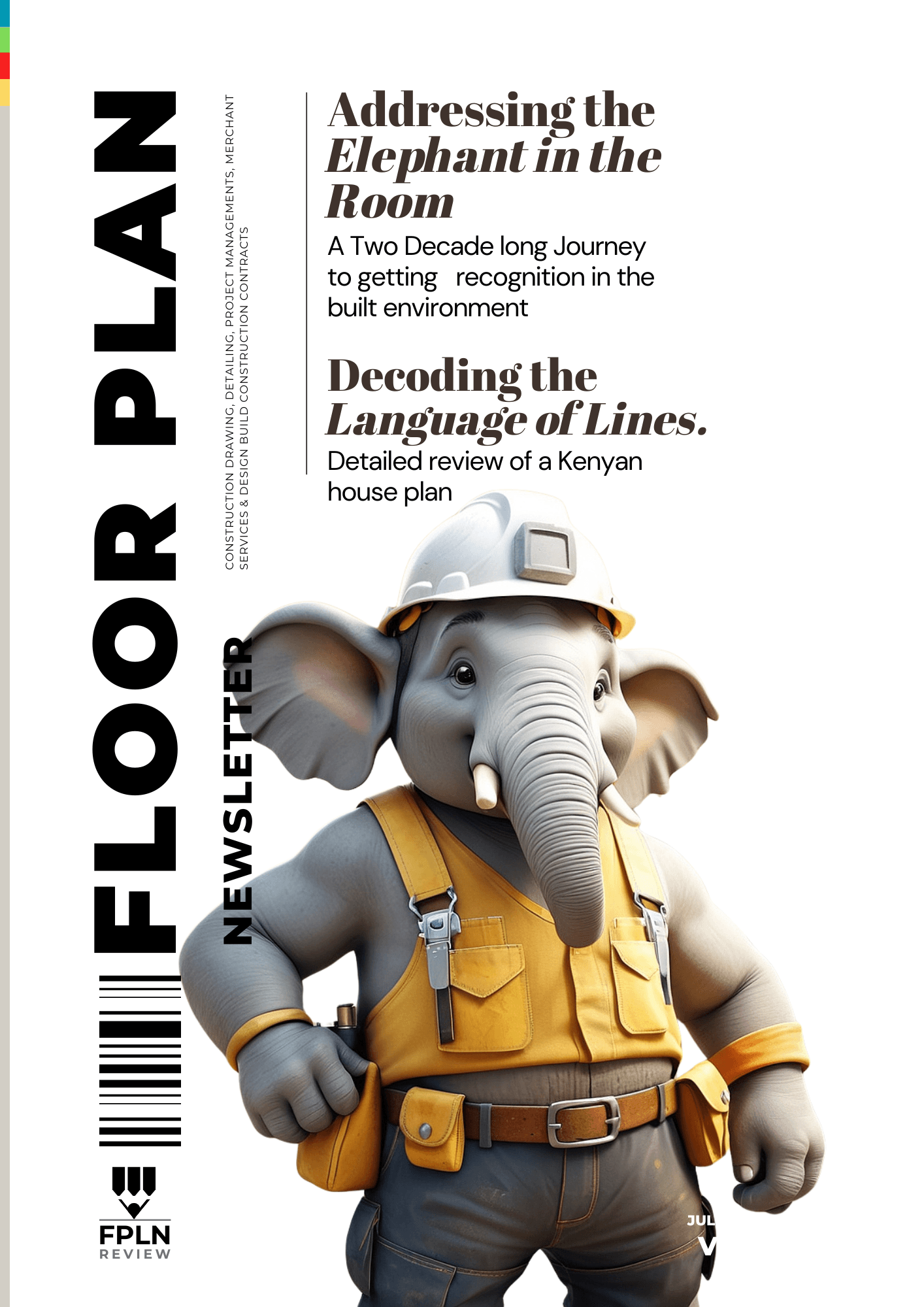
FLOOR PLAN
The latest issue is available in print and digital format